Welcome!

My Hospitality & Nature Conservation experience on Sondela!

Wednesday, 2 November 2011

Trees

Trees:


Wiregrass Region

The Wiregrass Region or Wiregrass Country is an area of the Southern United States encompassing parts of southern Georgia, southeastern Alabama, and the Florida Panhandle. The region is named for the native Aristida stricta, commonly known as wiregrass due to its texture.


Wiregrass, also called pineland threeawn, is one of the most common grasses in the southern pine flatwoods and upland sandhills.

It is a favorite food of gopher tortoises and quail and provides valuable cover for many birds, reptiles, and small mammals. The young plants may also be used as a forage by livestock.


This is a fast growing species that regenerates quickly after fires. The plant depends on regular summer burning in order to stimulate flowering and seed production.

Wiregrass is often confused with a similar plant, piney woods dropseed (Sporobolus junceus), which also has long, thin, wiry leaves. However, wiregrass has small tufts of hair at the leaf base; the dropseed stems are smooth and hairless.

Wiregrass is limited to the southeastern United States. It ranges from Mississippi to Florida but only as far north as South Carolina.
 Identifying Characteristics
Size/Form:
Wiregrass is a perennial bunch grass that grows in dense, spreading tufts, reaching heights of 1½' to 3'.
Leaves:
The leaves are long, thin, wiry, or needle-like with tufts of fine, white fuzz around the leaf base. Margins are rolled inward.
Flowers:
Wiregrass flowers are tiny and close to the flower stalk with 3 distinct hair-like awns protruding from each flower.
Fruit:
The fruit is a tiny, yellowish grain (seed).
Habitat:
Wiregrass grows prolifically in flatwoods and dry sandhills. It is a common understory cover in longleaf pine forests and on newly burned sites.


Uses:
It is an unpalatable grass due to the bitter taste and wire leaves.
It is one of the first grasses to sprout in spring and is then utilised when little other grazing is available.
Its abundance in veld is an indicator of overgrazing in the past.
It seems to increase through regular veld fires and is one of the firs grasses to disappear when is not grazed or defoliated in other manner. Wire grass contains an essential oil about 25 ingredients, of which cineole and camphene are two of the most important.   


Common Thatching Grass

   (Hyparrhenia Hirta)

Hyparrhenia hirta is a species of grass known by the common names common thatching grass and Coolatai grass. It is native to much of Africa and Eurasia, and it is known on other continents as an introduced species. In eastern Australia it is a tenacious noxious weed. In South Africa, where it is native, it is very common and one of the most widely used thatching grasses. It is also used for grazing livestock and weaving mats and baskets.
This is a perennial grass forming clumps 30 centimetres to one metre tall with tough, dense bases sprouting from rhizomes. The inflorescence atop the wiry stem is a panicle of hairy spikelets with bent awns up to 3.5 centimetres long. The grass can grow in a variety of habitat types, in dry conditions, heavy, rocky, eroded soils, and disturbed areas.


Common Thatching grass
Hyparrhenia hirta is recognized by its hard basal tussock, rough narrow leaves and a scanty panicle of pairs of white villous racemes which do not deflex (bend downwards).

Description:
Hyparrhenia hirta is a wiry, tufted perennial grass usually 300-800 mm high, rhizomatous and with slender culms. The leaf blade is 20-150 x 1-2(-4) mm. The panicle is scanty, consisting of 2-10 raceme pairs which are 20-40 mm long, never deflexed, bases unequal, cylindrical, 8–14 awns, 10-35 mm long, with hairs up to 0.3 mm long. The base of the upper raceme has 0–1 homogamous (same sex) pairs of spikelets. A sessile spikelet is 4.0–6.5 mm long, yellowish green to violet, white-villous and the callus is acute. The pedicelled spikelet is white villous and awnless. Flowering time: September to June. See glossary for terms in Gibbs Russell et al. (1990).

Conservation status:

The SANBI Threatened Plants Programme has not, as yet, indicated its conservation status, but so far, Hyparrhenia hirta is widespread, and is good for grazing in spring and early summer, so conservation is practised indirectly.

Conservation status:

The SANBI Threatened Plants Programme has not, as yet, indicated its conservation status, but so far, Hyparrhenia hirta is widespread, and is good for grazing in spring and early summer, so conservation is practised indirectly.

Derivation of name and historical aspects:

Hyparrhenia hirta is derived from the Greek words, hypo, meaning under, and arren, meaning masculine, alluding to the male spikelets at the bases of the racemes. The species name hirta is from the a Latin word meaning hairy, probably referring to the hairy spikelets. The genus Hyparrhenia has ± 55 species, mostly in Africa, a few species in other tropical regions and the Mediterranean, and 20 in southern Africa, where it is widespread.


Ecology:
Hyparrhenia hirta is pollinated and seed dispersed by wind.

Hyparrhenia hirta is the most competitive species in infertile areas, but not in areas where other fertile species occur. Once established, Hyparrhenia hirta is difficult to control.

Uses and cultural aspects:
Hyparrhenia hirta is probably the most popular thatching grass used in South Africa. It is grazed by livestock early in the growing season and after fires, but becomes less palatable for grazing later. In South Africa and the USA this grass is seen as a drought resistant grass, which protects the soil and stabilizes hard, gravelly soil and eroded places. It is also used to weave mats and baskets.

Hyparrhenia hirta is self-fertile, enabling new populations to arise from a single plant. Seed can germinate readily in different light regimes, over a wide range of temperatures, pH levels and under marginal water stress. Seedlings can emerge from a depth of up to 9 cm. Seedling recruitment can occur within established stands and in soil with a plant litter layer.


 Foxtail Buffalo Grass:   

Cenchrus ciliaris is a perennial, tufted grass. The inflorescence is a bristly 'spike' (like a cat's tail) and is nearly always purple to straw-coloured.

Description:

A tufted perennial grass, 60–100 cm high. Leaf blades 100–250 x 4–8 mm. Inflorescence (Gibbs Russell et al. 1990): a bristly false spike, 40–120 mm long, straw- or purple-coloured; all bristles are joined at base below spikelet cluster to form a small inconspicuous disc, bristles mostly 5–10 mm long, outer bristles slender and scabrid, inner bristles slender and plumose. Spikelet 4–5 x 3 mm; lower glume (the bracts at the base of the spikelet) 1-nerved or nerveless and upper glume 1–3-nerved, minutely awned; lower lemma usually 5-nerved, minutely awned; upper lemma similar to lower lemma (encloses grass flower), slightly thicker in texture; anther 1.5–2.7 mm long. A variable species, with many cultivars available e.g. Malopo. Flowering: August to April.

 
Conservation status:

The SANBI Threatened Plants Programme has not yet indicated its conservation status, but as it is a drought-resistant perennial, which, during drought plays an important role as a pasture to livestock, it is valued and conservation is practiced indirectly.
Distribution and habitat:

It occurs in the more arid parts of southern Africa and tropical Africa, the Mediterranean areas, and in Arabia to India. Introduced to Australia and other hot, drier areas of the world where it has been imported as cultivated pasture. Foxtail buffalo grass grows in dry, warm parts. It grows in all types of soil, but mostly in sandy soil and other well-drained soil types. It is often found along roadsides where it utilizes the additional runoff rainwater.
Ecology:

Common in hot dry areas, especially on sandy soils where it is often ruderal (grows in waste places), and also often on termitaria, on all types of soil. Cenchrus ciliaris ia pollinated by wind. It is adapted to fairly heavy grazing and a wide variety of conditions.
Uses and cultural aspects:
Cenchrus ciliaris is a palatable species with a high leaf production. Generally planted as pasture (Farming in South Africa leaflet 114. 1983. A cultivation guide). It is one of the most popular cultivated pastures, especially in the more arid
parts, with many commercially available cultivars. Foxtail buffalo grass can endure trampling.


It is easy to grow Cenchrus ciliaris, especially in lower rainfall areas on sandy soils. It is easily established by seeding. It is a hardy cultivated pasture with a deep root system (up to 2 m). Foxtail buffalo grass is difficult to establish in clay soil, but once established, it grows well. In the garden it is best used as a lawn grass, this is common in India.

Monday, 31 October 2011

Birds day 3

Birds day 3:


Types of Bird Feathers:

There are 6 commonly recognized types of feathers:


  • Vaned or contour:  From the outer coverings of a bird's body, including the wing & tail feathers. 
  • Down: Layer of loosely structures feathers beneath contour feathers which help to trap air near the birds body from warmth.  Nothing beats the warmth of down!
  • Semieplume: Loose & fluffy feathers similar to down feathers; provides body insulation  and increases the buoyancy of water birds.
  • Filoplume: Small hair-like feathers with a few barbs at he tip of the shaft; they occur among the contour feathers.
  • Bristle: Modified, vaneless contour feathers with only a few barbs at the base on a small, stiff rachis. They can occur around the eyes, nostrils, and in flying insect-catching birds around the mouth, called rictal bristles.
  • Poweder down: Feathers that grow continuously and are never molted.  The barbs at their tips constantly disintergrate into a fine, talc-like, water-resistant powder.  Often abundant in birds that lack preen glands.
 Foot Structure:


Aquatic bird:


Bird with lobed toes for ease of swimming.


Bird of prey:


Poorly adapted to locomotion, theses sturdy powerful legs have talons to grip prey, immobilizing and killing it.

Perching bird:

The four toes end in a nail, which wraps around a support when the bird is resting; the hind toe provides equilibrium.


Bird feet:


Coot feet:


Mallard feet:


Hawk feet:


Woodpecker:


Wednesday, 26 October 2011

Birds day 2

Bids day 2:

What is the definition of   Passerine ?

Of or relating to the relating to the largest order (Passeriformes) of birds which includes over half of all living birds and consists chiefly of altricial songbirds of perching habits-compare.


What is the definition of   Non-Passerine ?

Non passeriena especially: of, relating to or being any of various arboreal birds ( As pigeons, woodpeckers, hummingbirds, and kingfishers) that are not passerines.

Altricial:

Meaning "requiring nourishment", refers to a pattern of growth and development in organisms which are incapable of moving around on their own soon after hatching or being born.  The wood is derived from the Latin root alert meaning "to nurse, rear, or to nourish", and refers to the need for young te be fed and taken care of for a long duration.

Precocial:

Refers to species in which the young are relatively mature and mobile from the moment ob birth or hatching.


Bird identification :


  • Keep your eye on the bird
  • Listen for calls and songs
  • Estimate general size and shape
  • Make note of facial markings and bill charateridtics
  •  Look for wing bars and tail shape
  • Observe leg color and length
  •  Study movement and flight patterns
  •  Determine feeding habits
  • Describe habitat, region, and climate
  •  Record your observations

 Flight patterns:


Brood parasites:

are organisms that use the strategy of brood parasitism, a kind of kleptoparasitism found among birds, fish or insects, involving the manipulation and use of host individuals either of the same (intraspecific brood-parasitism) or different species (interspecific brood-parasitism) to raise the young of the brood-parasite. This relieves the parasitic parent from the investment of rearing young or building nests, enabling them to spend more time foraging, producing offspring etc. Additionally, the risk of egg loss to raiders such as raccoons is mitigated, by having distributed the eggs amongst a number of different nests. As this behaviour is damaging to the host, it will often result in an evolutionary arms race between parasite and host.


Feathers:

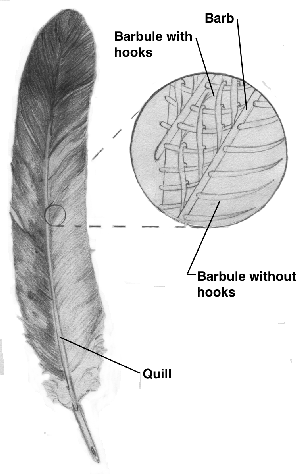
Feather are unique to birds: Engineered by evolution, their extreme lightness combined with exceptional strength and flexibility makes feathers the ideal flying gear.  They constitute a truly multi-functional body-suit that is also, water carriers, versatile all-weather gear or as dashing courtship finery.  They can provide a camouflaged covering, rendering birds almost invisible, or their bright iridescent  splashes of colour can turn heads.


Tuesday, 25 October 2011

Birds


 Breeding season:

It is usually during their climate's spring to summer seasons, since that's when food & water are most abundant, and the humidity and temperature is at it's prime for raising temperature/humidity sensitive baby birds.

(Usually starting after the "rainy season," which is early spring) So that by end of summer, their babies are raised and able to care for themselves so they can find mates and migrate with them, if they are migratory.

Most birds do not come back to the exact same nesting spot they used the year before, but most do come back to the same area. (And by area, I mean state). You can tell whether a bird uses his nest repeatedly over the years, depending on how he treats his nest.

Since this allows each individual the important opportunity to pass its genes on to the next generation.  For this reason, it is a time of frenetic activity where impassioned displays, fervent singing and hot-blooded threats all form part of the zealous competition for mates and territories.  While some birds show extreme loyalty to their partners and mate for life, others choose a new mate every breeding season.  In some species, the males are blatantly promiscuous, attracting an entire harem of females each season, mating with and then abandoning them to brood and rear the young alone.  In other species, breeding is a family affair, and not the job of just the biological parents alone: the whole extended family group co-operates and works together to rear the blood.


 Bird territorial behaviour:

Birds choose a territory because it can meet their needs for food, water, shelter and nesting sites. The size of the territory will vary by species, and where some bird species need large territories with little competition, other birds have much more communal needs and are more apt to share territory with larger flocks. The size of a bird's territory can also vary from year to year depending on how viable the land is – in a year where there are excellent food sources, for example, a bird may claim less territory than in years where food is scarce.
The amount of aggression birds show defending their territory also varies based on the species and their interaction with one another. An American robin, for example, will chase away other robins from its territory, but it won't mind a white-breasted nuthatch sharing the same space because the two species do not directly compete for food sources.
How Birds Claim Territory
Migratory birds may begin to claim territory in late winter or early spring as mature males arrive from their wintering grounds and seek to find the best places where they hope to attract a mate. Non-migratory birds will also renew their claims on territory at this time, in part to attract their own mates and renew bonds but also to let arriving migrants know that the territory is already claimed.
Birds claim territory through a number of behaviors, including:
  • Singing: Singing is one of the most common ways birds advertise that a territory belongs to them. Songs will carry quite far, and birds will perch near the edge of their territory to broadcast their claim to the maximum range. At the same time, the strong, vibrant song will help attract a mate. For some species, such as the northern mockingbird, a more complex song will help birds defend a larger territory and is more attractive to females.
  • Nest Building: Some birds, such as different types of wrens, will claim territory by taking advantage of the nesting sites it offers. The males will build multiple nests in suitable locations throughout their territory, and the females will investigate those nests and choose the one they prefer, even if they eventually rebuild the male's construction.
  • Drumming: Woodpeckers and several types of game birds claim territory by drumming as an alternative to singing. These low-pitched sounds – whether made by pounding on a hollow tree or by using air sacs – will carry great distances and alert competing birds that the territory is not available, as well as let potential mates know that a strong, healthy bird has claimed the location.
  • Visual Displays: Visual displays such as puffing up colored feather patches, tail flicking or fanning, wing spreading and other behaviors are all part of claiming territory and also show off a bird's strength and health to a potential mate. These behaviors are commonly a part of courtship rituals between opposite sexes as well as territorial displays between two male birds.
  • Chasing: As a last resort, aggressive birds may directly chase intruders or competitors out of their territory. This is frequent in areas where many birds are seeking to claim the same territory, or when a dominant male is discouraging younger males that are struggling to claim their first territory. In bird species where family groups remain together in the winter, the male parent may chase away his mature offspring the following spring so they do not infringe on his territory.
Most birds will use a combination of different behaviors to claim and defend territories, particularly in competitive seasons. Understanding this type of behavior can help birders better appreciate the birds they see and learn more about where to find certain species.
When Territory Doesn't Matter
There are two instances when territory is less important to birds. The first is when a bird species is not territorial at all, such as with communal nesting birds. Swifts, swallows, herons and many waterfowl are communal nesters and will have only very small territories directly around the nest site that they may defend.
Birds are also much less territorial after the breeding season ends. At this time, many birds that would have aggressively defended their space just a few weeks earlier are now gathering together for migration and are less apt to be aggressive. Even non-migratory birds are less aggressive at this time, since competition is easing for food sources and they no longer have the demands of growing chicks to meet.
Understanding bird territories and how they claim those territories helps birders know where and how to find birds in the spring and summer, and territorial behaviors can be astonishing to observe.

Nesting:
The Avian ‘PROPERTY MARKET’ is as varied as the human one, ranging from ‘penthouses’ to ‘huts’. The majestic Secretarybird values a panoramic view, and builds its huge nest platform in the canopy of a large tree with a vista overlooking the open plains.  In contrast, the Cape Robin-Chat privacy of a thick bush.  Large, congested colonies of herons and egrets, while the floating houseboat-like nests of the Little Grebe and Red-knobbed Coot lie moored on the water below.  Some eagles build huge nests or ‘eyries’ positioned on dramatic vertical cliff-face mansion like high-risk skyscrapers.  And nightjars, rather than building an elaborate mansion like that of the Hamerkop, build no nest at all, preferring to ‘camp’ in the open and lay their eggs on the ground.
You get different types of nets:
·       Classical cup-shapes
·       Woven balls
·       Saucers of sticks
·       Mud shelters
·       Stick mansions
·       Skyscrapers
·       ‘Camping’ in the open
·       Avian houseboats
·       Hollowed-out homes
·       Sealed in
·       Unique nests

Weaving Wizardry:

Weavers are renowned for being among the most accomplished weaving wizards of the bird world, with nests that are intricately and skilfully woven.  Each weaver species has specialized in a unique nest-making ‘formula’, and is able create nests of a distinctive shape and size.

Why building a nest?

Contrary to what is often thought, birds do not build nests primarily to sleep in at night, but rather for the important purpose of breeding.

A secure nursery

The main function of the nest is to provide a safe home environment for the developing eggs and growing the chicks.  The nest allows for constant, controlled conditions, offering the eggs, and later, the chicks, protections against bad weather conditions.  The materials used to build the nest often help insulate the eggs and keep them warm while the parent is away.

Who build the nest?

Depending on the specie, building the nest can be the task of both male and female working together, or just one of the pair.